


 Book a call
4 March 2026
How to Increase Conversion Rate for E-Commerce Stores in 2026
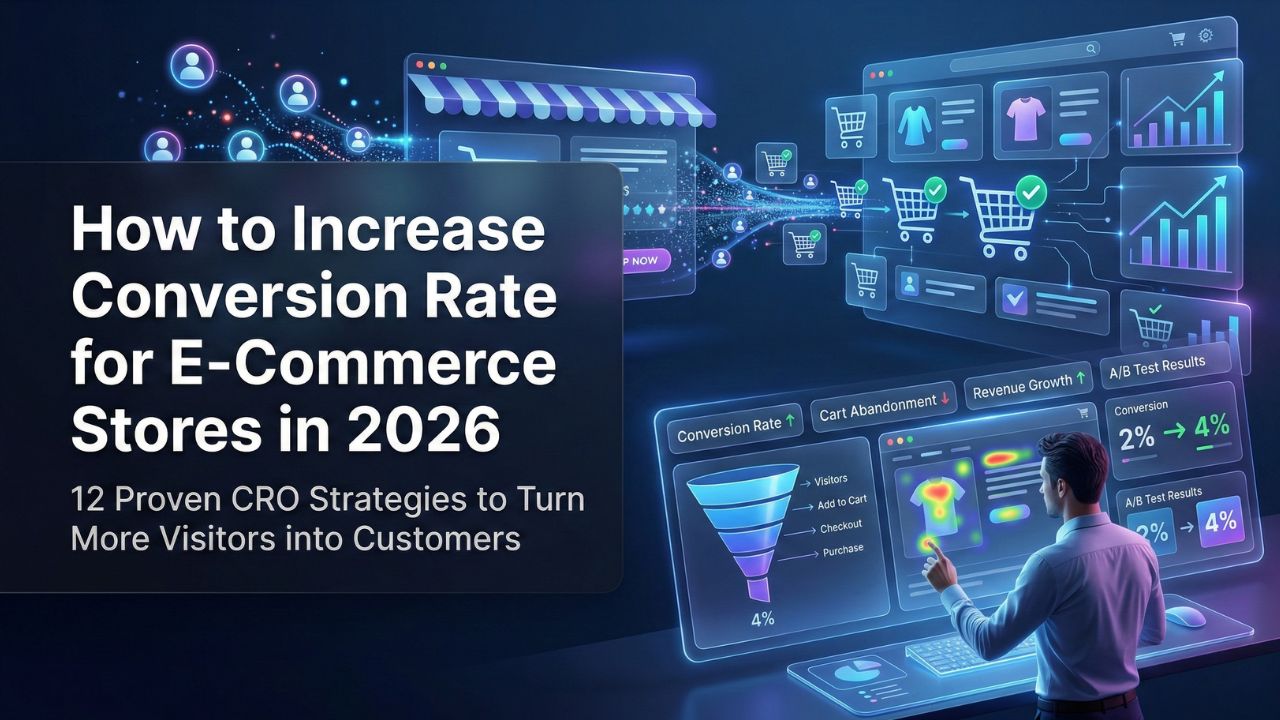
In 2026, driving traffic to your e-commerce store is no longer the biggest challenge — converting that traffic into paying customers is.
With rising ad costs, increased competition, and smarter shoppers, simply running ads or ranking on Google is not enough. If your website gets visitors but sales remain flat, the real issue may be your conversion strategy.
That’s where Conversion Rate Optimization (CRO) becomes critical.
In this guide, you’ll learn how to increase conversion rate for e-commerce stores using proven, data-driven strategies that work in today’s competitive digital landscape.
What Is Conversion Rate Optimization (CRO)?
Conversion Rate Optimization (CRO) is the process of improving your website to increase the percentage of visitors who take a desired action — such as making a purchase, signing up, or filling out a form.
Conversion Rate Formula:
Conversion Rate = (Conversions ÷ Total Visitors) × 100
For example:
If 1000 visitors come to your store and 30 make a purchase, your conversion rate is 3%.
CRO focuses on:
- Improving user experience
- Reducing friction
- Testing different layouts and messaging
- Optimizing checkout flow
Unlike traffic-focused strategies, CRO helps you generate more revenue from the same traffic.
Why Conversion Rate Optimization Matters in 2026
E-commerce in 2026 is more competitive than ever.
Here’s why CRO is essential:
- Paid ads are more expensive
- Privacy changes limit tracking
- Customers expect seamless experiences
- Mobile commerce dominates
- Attention spans are shorter
If your store isn’t optimized, you are leaving money on the table.
This is why many brands now invest in professional Conversion Rate Optimization (CRO) Services to maximize ROI without increasing ad spend.
How Is CRO Different from SEO and Performance Marketing?
Understanding the difference is important:
- SEO brings organic traffic.
- Performance Marketing drives paid traffic.
- CRO converts traffic into customers.
Think of it this way:
Traffic generation gets people to your store.
CRO makes them buy.
Without CRO, even the best SEO or paid campaigns will underperform.
How CRO Improves User Experience (UX) and Brand Trust
CRO is not just about buttons and colors. It directly impacts:
- Website speed
- Navigation clarity
- Product page design
- Checkout simplicity
- Trust signals (reviews, guarantees, policies)
A smoother experience builds credibility. When users trust your brand, they convert faster.
This is why working with an experienced Integrated Digital Marketing Company can help align design, marketing, and optimization strategies under one unified growth plan.
12 Proven Ways to Increase Conversion Rate for E-Commerce Stores
Here are actionable strategies you can implement:
1. Improve Website Speed
Even a 1-second delay can reduce conversions significantly.
2. Simplify the Checkout Process
Remove unnecessary steps. Offer guest checkout.
3. Use High-Quality Product Images
Clear visuals reduce hesitation.
4. Write Benefit-Driven Product Descriptions
Focus on solving problems, not just listing features.
5. Add Customer Reviews and Testimonials
Social proof increases trust instantly.
6. Display Trust Badges
Secure payment icons and return guarantees reduce anxiety.
7. Optimize for Mobile
Most shoppers browse and buy on mobile devices.
8. Use Clear Call-to-Action Buttons
Make CTAs visible and action-oriented.
9. Reduce Cart Abandonment
Send reminder emails and offer limited-time incentives.
10. A/B Test Landing Pages
Test headlines, images, layouts, and CTAs.
11. Offer Multiple Payment Options
Credit cards, PayPal, and BNPL options increase completion rates.
12. Use Live Chat Support
Answering questions instantly prevents drop-offs.
Step-by-Step Process to Increase Conversion Rate
If you want a structured approach, follow this:
Step 1: Analyze Your Data
Use analytics tools to identify drop-off points.
Step 2: Identify User Behavior Issues
Look at bounce rates, exit pages, and heatmaps.
Step 3: Create Hypotheses
Example: “Shorter checkout will increase conversions.”
Step 4: Run Controlled A/B Tests
Test one change at a time.
Step 5: Implement Winning Variations
Scale what works.
Step 6: Continuously Optimize
CRO is ongoing, not a one-time fix.
How Long Does It Take to See Results from CRO?
Most stores start seeing measurable improvements within 30 to 60 days, depending on:
- Traffic volume
- Testing speed
- Complexity of issues
- Implementation quality
CRO is a long-term revenue growth strategy.
When Should You Consider Professional CRO Services?
You should consider expert Conversion Rate Optimization (CRO) Services if:
- Your store gets consistent traffic but low sales
- You run paid ads, but the ROI is low
- You don’t have in-house testing expertise
- Your checkout abandonment rate is high
- You want predictable revenue growth
A data-driven approach from an experienced team can uncover hidden growth opportunities.
Frequently Asked Questions
Q1: What is a good e-commerce conversion rate in 2026?
Typically between 2% and 4%, depending on industry and traffic quality.
Q2: Is CRO better than running more ads?
CRO improves the efficiency of your existing traffic, often delivering better ROI than increasing ad spend.
Q3: Can small e-commerce stores benefit from CRO?
Yes. Even small improvements can significantly impact profitability.
Q4: Does CRO improve SEO rankings?
Indirectly, yes. Better user engagement signals can support SEO performance.
Q5: Is CRO a one-time process?
No. It’s continuous optimization based on data and user behavior.
Conclusion
Driving traffic is important - but converting that traffic is what drives revenue
In 2026, e-commerce success depends on how efficiently your website turns visitors into customers.
By implementing strategic improvements, testing consistently, and focusing on user experience, you can significantly increase your conversion rate and maximize profitability.
If you want expert guidance, partnering with an experienced Integrated Digital Marketing Company that offers specialized Conversion Rate Optimization (CRO) Services can help you unlock scalable growth.